Ethnographic Research Guide
An Ethnography "seeks a nuanced understanding of the lifeworld of a community—its social relations, its rhythms, its cultural norms, its patterns of power and decision-making, its ways of being, and so on—in order to comprehend the many relations between multiple actors and the material world they occupy and how such relations are constituted and continuously unfold. The researcher goes beyond surface descriptions (what is seen and heard), and seeks to gain a deeper understanding of why it is happening by being part of the relations and practices being studied."
Rogers, Alisdair, Noel Castree, and Rob Kitchin. "ethnography." A Dictionary of Human Geography. Oxford University Press, 2013. Oxford Reference.
In WR121, your assignment is to write an analytical, informative, and thought-provoking profile of a place. This will require you to research your place, provide an interesting observation of its history, components, and ecology, and explain its significance to the community.
When it comes to exploring the history of your place, it may help you to start thinking of different communities who are tied to the place. For example, consider different nationalities, ethnicities, city/state residents, neighborhoods, or schools.
The kinds of people who work in or otherwise occupy the space, as well as their cultural productions, political, social, religious, cultural, or local issues may help you obtain a more holistic view of your place.
Other points of interest may include organizations like clubs or churches, events like conferences, conventions, ceremonies, or sports, or even activities like cooking, gardening, climbing, or geocaching.
The online library at CGCC can help you get started with your research. You can find books, ebooks, videos, articles, and more. Begin searching on the homepage: https://cgcc.edu/library.
Don't forget you need to register for a library account to use our online databases and place holds for items in our physical collection!
- Once you have access to our research databases, select one with a description that matches your topic. Databases in the General Subject tab cover a variety of topics, so they are a great starting point!
- Useful databases for ethnographic research include Points of View, Humanities Abstracts, Films on Demand, U.S. History in Context, Newspaper Source and Infotrac Newsstand
- Databases work best when you add one search term per box:
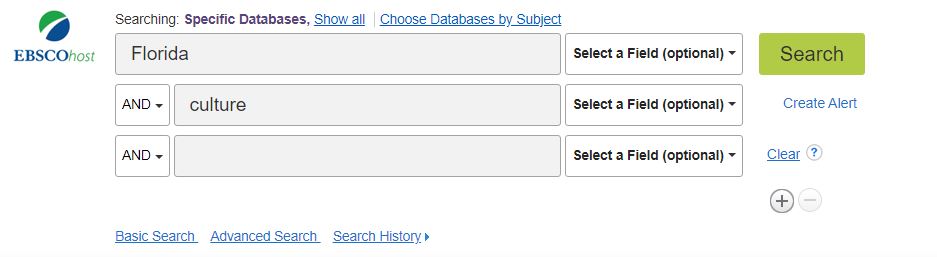
Try using terms like ethnology, culture, or customs. (Please note the above search for Florida AND culture provides over 3,000 results from this database alone. You can narrow this down with more specific terms and keywords. For example, adding "Zora Neale Hurston" to the third box includes six results that investigate the state's ethnographic culture through the perspective of the African American historian and author who grew up there.
- Try adding your subculture to your search
- For example, Eatonville is the first Black community in Florida. Today, this area and its historical sites are enveloped by Orlando.
- If you aren't getting the right results from your subculture, try adding quotation marks around the keyword or phrase
- For example, "Zora Neale Hurston" will only include results with the author's full name.
- Use an asterisk (*) to find variations of the same root word.
- For example, ethnograph* will include results for ethnography, ethnographies, ethnographic, etc.
Writing an ethnographic profile will require you to learn more about the issues connected to the place you choose. Here are some tips for identifying historical and social issues that undergird your studies:
- Consider the colonial and Indigenous history of your place:
- You can't find a corner of the American continent that does not hold ancient history, Indigenous valued, and pre-colonial place names and stories. Every place we occupy once served as the homeland for other people, who often didn't leave that place willingly.
- Ask yourself: Whose land is my place on?
- Visit native-land.ca to map Indigenous languages, treaties, and territories associated with your place. (Your findings will make great keywords when you access our library databases!)
- Ask yourself: Whose land is my place on?
- You can't find a corner of the American continent that does not hold ancient history, Indigenous valued, and pre-colonial place names and stories. Every place we occupy once served as the homeland for other people, who often didn't leave that place willingly.
- Consider other social issues connected to your place.
- Research isn’t always representative of the groups that you are hoping to serve for a number of reasons — whether that is a bias of the researcher, collection methods, or hesitation on the part of the audiences themselves. Collecting diverse perspectives can help you gain a more holistic and inclusive understanding of your place.
- Ask yourself: What economic inequality, gentrification, development/loss of habitat, issues with public land use policies, and historical record inaccuracies can I identify? Whose perspectives are being represented in the resources I'm finding?
- Consider using global databases to incorporate broader perspectives. For example,
- J-STAGE is a Japan-based database that circulates research in science, technology, humanities and social sciences.
-
Black Freedom Struggle in the United States is a collection that is focused on Black Freedom. It features primary source documents related to critical people and events in African American history.
-
The World Factbook provides information about history, people, government, economy, energy, geography, environment, communications, transportation, military, terrorism, and transnational issues.
-
Independent Voices is a collection of alternative press newspapers, magazines and journals produced by diverse creators including feminists, dissident GIs, campus radicals, Indigenous peoples, antiwar activists, Black Power advocates, Hispanics, LGBTQIA+ activists, the extreme right-wing press.
- Consider using global databases to incorporate broader perspectives. For example,
-
In all your searches, be sure to include your subculture in your list of keywords. (For example, the search indigenous AND Florida AND culture will help prevent your search results from prioritizing only white narratives.
- Ask yourself: What economic inequality, gentrification, development/loss of habitat, issues with public land use policies, and historical record inaccuracies can I identify? Whose perspectives are being represented in the resources I'm finding?
- Research isn’t always representative of the groups that you are hoping to serve for a number of reasons — whether that is a bias of the researcher, collection methods, or hesitation on the part of the audiences themselves. Collecting diverse perspectives can help you gain a more holistic and inclusive understanding of your place.
Perspective is an important element of research design, conduct, and reporting. Social issues impact many people and represent longstanding problems or disagreements that are difficult to resolve. Strong beliefs and viewpoints is a natural outcome of public discourse. These issues are important research topics because they help us understand there are many ways to think about problems.
For individual researchers, this means asking yourself:
- Whose perspective do my current resources represent and whose voices are missing?
- For example, a government website about a state park may be credible, but still gloss over the colonial history of your research topic.
- Determine the perspectives you are choosing to adopt for your assignments and declare them.
- Combine a wide variety of primary (firsthand accounts of a topic that include interviews, legal document texts, speeches, photographs and original research) and secondary (one step removed resources that contain a layer of interpretation) to allow consideration of multiple relevant perspectives.
For more help finding and evaluating resources, check out our Finding Information Research Guide!